
What Happens When AI Builds Your Personal Backrooms?

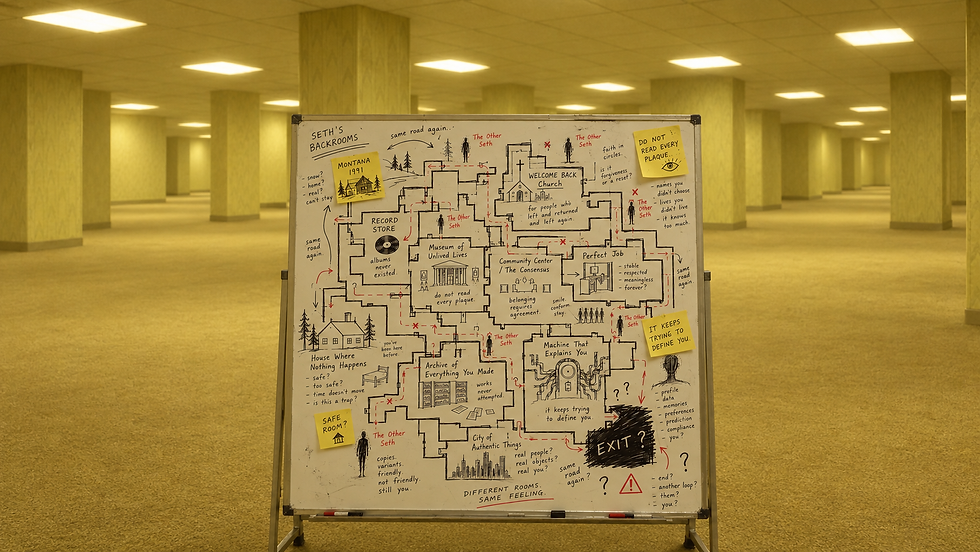
Backrooms (2026) sent me down a separate rabbit hole: if a machine already knows something about the way you think, what kind of AI Backrooms nightmare would it build for you?
By Seth Metoyer | MoreHorror.com
I finished watching Backrooms and found myself thinking less about the mechanics of the place and more about the insult of it. The Backrooms take something ordinary, something architectural and functional, and strip away the purpose until all that remains is fluorescent light, walls, carpet, repetition and the growing suspicion that the building understands something you do not.
There is a peculiar kind of horror in a universe that offers no explanation and no obvious hostility, because eventually your own brain starts supplying the missing pieces. You want the room to have meaning. You want the hallway to lead somewhere and the door to exist for a purpose. The Backrooms have always known that people feel uneasy when architecture doesn't align with your story. That's creepy.
When the Maze Starts Knowing You
That was the main idea rattling around in my head when I wandered into a completely separate question. Now, I'm not suggesting that Backrooms is a movie about artificial intelligence, because it isn’t, and the internet already has enough people shadowboxing arguments nobody actually made. The film simply sent me down another corridor. I started wondering what would happen if the Backrooms stopped being generic and began tailoring themselves to the person trapped inside them. Then I pushed the idea a little farther: what if you asked an AI you had already spent a great deal of time talking with to design your personal Backrooms from what it had learned about you?
There is already something faintly unsettling about that premise before the monsters wander into the area. People use ChatGPT, Gemini, Claude, Copilot and other systems for everything from research and brainstorming to personal conversations, creative work and the kind of late-night questions we once reserved for journals, long drives and unfortunate phone calls to friends. Over time, those conversations create a strange residue. Interests repeat. Fears reappear under different names. Old obsessions keep crawling back into the room. Certain questions become almost liturgical. If you talk to one of these systems long enough, it begins to recognize patterns, or at least construct a convincing model of those patterns from what you have voluntarily given it.
So I decided to turn that unease into a horror exercise.
I asked ChatGPT to imagine my personal Backrooms using the broadest picture it had of me across our conversations. This idea actually came from my wife and I talking about the film after we watched it together. Basically, I told Hugo (yes, I have named my GPT bot) to ignore whatever I had been talking about most recently and to give greater focus to patterns that appeared across unrelated parts of my life. I wanted memory, worldview, nostalgia, creative instincts, fear, identity, belonging, mortality, authority, contradiction and all the other little pieces that tend to follow a person around whether invited or not. Then I asked it to build the rooms, the traps, the entities and the false exits around those things.
Things escalated quickly.

My Backrooms Remembered Too Much
My Backrooms didn't begin with a monster. They began somewhere that looked almost like Montana around 1991, which already felt like a low blow. Snow sat outside. A road stretched into the dark. An old cassette played songs I recognized until the lyrics changed and began describing things that had not happened yet. Familiar places appeared with tiny mistakes inside them. A record store sold albums from bands that never existed. A church I had never attended displayed a sign that said, “WELCOME BACK.”
That particular version of horror resonates with me because nostalgia has always been more significant than I’d probably like to admit. Music can reopen whole rooms in my head. Certain records, movies, objects and places can collapse decades in a few seconds, and anyone who has ever been ambushed by a song from high school in a grocery store knows the mechanism. My Backrooms took that reflex and turned it poisonous. They offered the promise of going back, then quietly suggested that the past itself had started changing the locks.
Another room became something called the Museum of Unlived Lives, which may be one of the most effective ideas the exercise produced. Inside were different versions of my life arranged like exhibits: the version of me who took the safer career, the version who found greater success, the version who made different choices, the version who eventually figured everything out. One exhibit contained an older, peaceful version of myself sitting somewhere I desperately wanted to reach, except a velvet rope blocked the path and the plaque beneath him read, “SPECULATIVE RECONSTRUCTION.” Then, there were other versions of me that manifested into my own monster. Nightmare fuel.

The Backrooms in that version kept returning to the same pressure point: identity. Who gets to define you, and how much of that definition comes from choices you made, choices you avoided, people who knew you, institutions that categorized you, audiences who interpreted you and older versions of yourself who would probably find the current version suspicious? A recurring figure called The Other Seth appeared throughout the map at different ages, sometimes younger, sometimes older, never chasing me and rarely speaking. He simply watched. That somehow felt worse.
The architecture eventually became a maze built around authorship. One room represented conformity. Another represented a life of stability stripped of creativity. Another catalogued every project I had completed and every project I never attempted. A machine tried endlessly to explain me through profiles, preferences and predictions. The exit remained uncertain. Every level seemed to ask the same question in a different costume: if enough outside forces describe you convincingly enough, at what point do you start mistaking the description for yourself?
That gave me one kind of Backrooms.
I Put the Experiment Out to the Horror Community
I wanted to know whether the idea would hold up once it left my own conversation history, so I turned the experiment into a short Instagram video and put it in front of the horror community. The invitation was simple: if you already use ChatGPT, Gemini, Claude, Copilot or another conversational AI and feel comfortable doing it, ask the system what your personal Backrooms would look like based on what it has learned about you over time. I also made it clear that I was not suggesting Backrooms itself has anything to do with AI. The film simply sparked the question, and the experiment became its own strange little hallway from there.
The post got plenty of attention and likes, but fewer people actually stepped through the door, which honestly makes sense. There is a difference between enjoying the concept and handing over a piece of your psychological furniture for public inspection. My wife Shannon did take the challenge, and her result ended up giving the experiment exactly what it needed: a completely different kind of personalized horror.
If anyone reading this wants to try it, the invitation is still open. Run the prompt through whatever conversational AI you already use, see what kind of Backrooms it builds from your memories, fears, habits, obsessions and recurring patterns, and send me the parts that hit hardest. If you are comfortable with me quoting the response and crediting you, I would still love to hear from more people in the horror community and may include additional examples in a future update or follow-up feature.

Shannon’s Backrooms Learned How to Hunt
Shannon, who also goes by Cat online and who some of you may know as @snickersnee on Instagram, ran the same general experiment through her own ChatGPT conversations. Her result moved in a completely different direction, and that difference became the thing that made the whole exercise worth pursuing. Her Backrooms were less interested in biography and more interested in hunting her through perception.
“Cat’s Backrooms would probably start somewhere almost comfortable: an empty California house in the late afternoon, quiet enough that she’d happily explore instead of immediately looking for an exit,” her response began.
“The problem is that every room leads into another house. Kitchens open into hotel corridors, closets contain staircases, and back doors lead to nearly identical neighborhoods. There are signs of people everywhere, warm food, running showers, televisions playing, but nobody answers when she calls.”
That is where her version gets smart. The empty house is not immediately threatening because solitude does not automatically frighten her. The place understands that and adapts accordingly. It does not need to chase her down a corridor when curiosity will do the work for free.
“The Backrooms could use curiosity instead of force,” the response said.
That line probably deserves to survive into the final version of this article because it contains the whole nightmare in seven words. Horror often works by turning a strength into a liability. Curiosity helps us survive, understand, create and discover. In the wrong room, curiosity becomes a leash.
Shannon’s Backrooms keep leaving bait. A phone rings inside a sealed room. A television shows the room she is currently standing in. One of her own possessions appears inside a house she has never visited. Every clue invites another step forward until the environment stops feeling empty and starts feeling occupied by something that has been studying her.

The Things in the House Get Better at Being Human
That is where the inhabitants arrive.
At first, they are easy to identify. Their limbs are wrong. Their faces do not quite fit. Their movements belong to bad imitations of human bodies. Some stay hidden and reproduce ordinary sounds: laughter, crying, someone calling from upstairs. Then they begin improving.
“Eventually the people she encounters look completely normal, leaving her to search for tiny mistakes,” the response said. “The friendly stranger never blinks, the woman at the window repeats the same wave perfectly, the man beside her still makes footsteps after he stops walking.”
There is something viciously effective about that progression because it gradually removes the one defense Shannon’s Backrooms initially allow her: observation. You can survive the first creature by noticing what is wrong. The second one requires closer attention. The third forces you to distrust the act of seeing itself.
Her final section makes the psychological mechanism explicit. “She values being left alone, having control over her own space, and being able to trust her own observations. This place would corrupt all three. Solitude would stop meaning she’s alone. Curiosity would keep leading her into danger. And eventually she’d meet something so convincing that careful observation couldn’t tell her whether she was looking at a person or something that had simply gotten very good at pretending to be one.”
That last idea acquires an extra layer of unease when you remember who generated it.
An AI system created a horror scenario about entities that become progressively better at imitating human beings.
You can hear the floorboards creak on that one without any help from me.
The Nightmare Starts With What You Trust

This is where the experiment moved beyond the novelty of asking a chatbot for a scary story. Shannon’s Backrooms and mine look almost nothing alike, yet both follow the same principle. The nightmare identifies something the person relies on, then breaks the contract.
I rely heavily on memory, identity, interpretation and the ability to maintain some distance from whatever group, institution or label wants to finish the sentence for me.
My Backrooms turn those things unstable. Shannon values solitude, autonomy, curiosity and the ability to trust what she sees. Her Backrooms weaponize those things against her.
That suggests a better question than “What scares you?” What do you trust?
A personalized nightmare has no reason to start with your obvious fears. It can begin with the things that make you feel safe. It can take a childhood road and change the destination. It can take solitude and quietly fill the room. It can take curiosity and keep placing interesting doors at the end of increasingly dangerous hallways. It can take your ability to observe the world and populate that world with things designed to survive your scrutiny.
That feels much closer to the machinery of effective horror. The best nightmares rarely announce themselves with a chainsaw in the first five minutes. They take something familiar and loosen one screw at a time.
How Much Does a Machine Need to Know?
The AI part of this experiment adds another uncomfortable dimension, and I think that dimension matters even for people who have zero interest in treating artificial intelligence as mystical or sentient. I don't think ChatGPT peered into my soul and found a secret room full of alternate Seths. Shannon’s system did not spiritually diagnose her through the glowing eye of some ancient god. These systems work from conversational history, patterns, context and inference. They take the material available and construct an interpretation from it.
The interesting question is how much material something needs before that interpretation starts feeling uncomfortably specific.
Human beings have spent centuries building haunted houses out of memory, guilt, grief, obsession and repression. Psychological horror gives interior states walls, windows and hallways because sometimes architecture explains fear better than dialogue can. A haunted hotel becomes addiction and inheritance. A town becomes guilt. A house becomes family history. The Backrooms fit neatly into that tradition because they give anxiety an address without giving it a meaning.
This experiment simply changes the order of operations. Instead of a writer creating a nightmare and hoping the audience finds themselves somewhere inside it, the audience supplies the raw material first and the nightmare gets built afterward.
That is where the idea starts getting strange.
The Door You Would Open Anyway
A personalized Backrooms doesn't need to know everything about you. It only needs enough information to understand which door you are likely to open.
For Shannon, it could be a telephone ringing behind a wall in an empty house. For me, it might be a record that shouldn’t exist, sitting in a store I somehow remember. Neither room has to pull us in. We’d walk in on our own.
That might be the version of the Backrooms I find most unsettling now. An endless maze can lose its power once the pattern becomes familiar. A maze built specifically around you carries a different kind of patience. It learns which memories you will follow, which sounds will make you turn around and which impossible little detail will keep you moving long after common sense tells you to stop.
The scariest Backrooms might never chase you. They could just know exactly what piques your curiosity—and leave the door wide open.


